Quick answer Checked November 2026
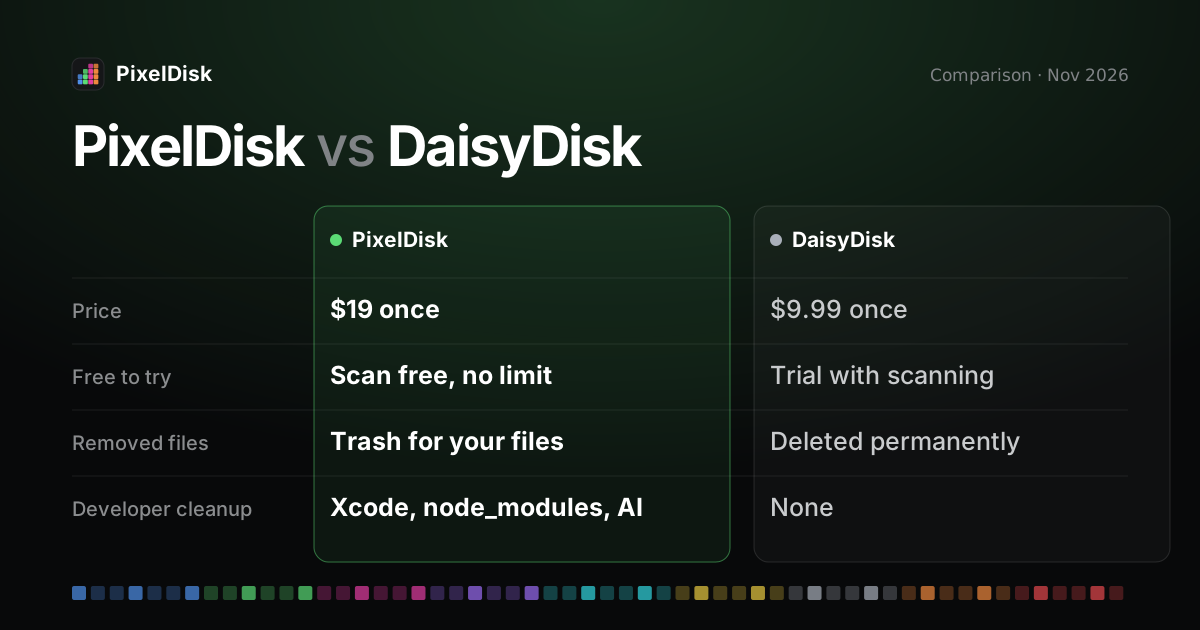
DaisyDisk is a $9.99 disk map that draws any drive as rings and deletes what you collect permanently. PixelDisk costs $19 once, works on the startup disk, labels what each item costs, and sends your files to the Trash in Safe mode.
- PixelDisk$19
- DaisyDisk$9.99
Pick PixelDisk if
- You want to know what is safe to clear
- You want your files kept in the Trash
- You clean Xcode, Docker or AI models
Pick DaisyDisk if
- You want the lowest price
- You scan external or network drives
- You only need a visual map
PixelDisk has two modes. Safe (the default) moves your files to the Trash, where you can put them back, and deletes caches and build files because apps recreate them. Full deletes everything at once after one confirmation.
DaisyDisk shows what fills your disk; PixelDisk also tells you which items are safe to remove and what each costs, such as “Next build is slower” or “Downloads again”. DaisyDisk costs $9.99 once and deletes files permanently (DaisyDisk, checked November 2026). PixelDisk costs $19 once and, in its default Safe mode, sends your files to the Trash, with a History to put them back.
The short version
DaisyDisk is a disk analyzer with a well-known ring map. You explore folders, drag what you don’t want into a collector, and delete it. You decide what each folder is.
PixelDisk groups the disk into nine categories and suggests the single biggest safe win. It knows what common folders are, especially developer ones, and labels the cost of removing them. Both are one-time purchases.
Comparison
| PixelDisk | DaisyDisk | |
|---|---|---|
| Price model | One-time | One-time |
| Price | $19 | $9.99, up to 5 personal Macs |
| Free tier | Scan and explore, no time limit | Free trial with scanning |
| Disk map | Pixel bar of 9 categories, folder treemap | Concentric rings (sunburst) |
| Disks | Startup disk | Startup, external and cloud drives |
| Says what’s safe and what it costs | Yes, per item | No, you decide |
| Developer cleanup | Xcode, simulators, Docker by kind and VM disks (direct edition), node_modules/target/build, AI models, git worktrees |
No |
| Where removed files go | Safe mode: your files go to the Trash; caches and build files are deleted (they rebuild) | Deleted permanently |
| Undo / history | History log; put back while in the Trash | No undo after deletion |
| System Data | Breakdown in direct edition | Shows System Data and APFS snapshots |
DaisyDisk details from its website and App Store listing, checked November 2026 (DaisyDisk, App Store). DaisyDisk also offers a 30-day money-back guarantee and protects system files from deletion.
Where PixelDisk is different
It knows what folders are
A disk map shows that ~/Library/Developer is large. It doesn’t tell you that most of it is simulator runtimes you can download again, or DerivedData that rebuilds on the next build. PixelDisk lists those as separate items with their sizes. It also lists Docker images and build cache, VM disks from Docker Desktop, OrbStack, Colima and Lima, and local models from Ollama, LM Studio and Hugging Face. See the guides on Xcode, Docker and AI models.
Your files go to the Trash
DaisyDisk’s collector deletes for good. In Safe mode, PixelDisk sends your own files, such as large files, downloads and models, to the Trash and logs them in History. If you needed that model, you put it back. Caches and build files are deleted at once because they rebuild.
It suggests one next step
Instead of a map to explore, PixelDisk shows the single biggest safe win at the top. You can still explore every category and folder yourself.
It skips what’s in use
PixelDisk won’t remove files that belong to running apps or that are open. A model loaded in LM Studio or a simulator that is booted stays where it is until you quit the app.
It works offline
PixelDisk needs no account and sends no analytics; its only network call is the update check, which you can turn off. DaisyDisk also states that it doesn’t track you (DaisyDisk), so both are fine on this point.
What PixelDisk doesn’t do
- It focuses on the startup disk. It has no view for external, network or cloud drives.
- It costs more: $19 against DaisyDisk’s $9.99, and DaisyDisk covers up to 5 Macs.
- No Windows version. It needs macOS 14 or later.
- The App Store edition is sandboxed. It sees only your Home folder and can’t uninstall apps. The Uninstaller, System Data breakdown, simulators, backups, Time Machine snapshots, VM disks and Docker cleanup need the direct download edition.
- No malware scan and no RAM or “speed up” tools.
Who should stay with DaisyDisk
Stay with DaisyDisk if you want a fast visual map of any disk, including external drives, and you already know which folders are safe to delete. It is cheaper, covers 5 Macs, and has a long track record, including App Store Editors’ Choice. If you mostly free space on your Mac’s own disk and want to know what removing each item costs, try PixelDisk for free and see pricing. Also compare the CleanMyMac alternative page.
Sources
Prices and features checked November 2026.
- DaisyDisk: https://daisydiskapp.com/
- DaisyDisk on the Mac App Store: https://apps.apple.com/us/app/daisydisk/id411643860