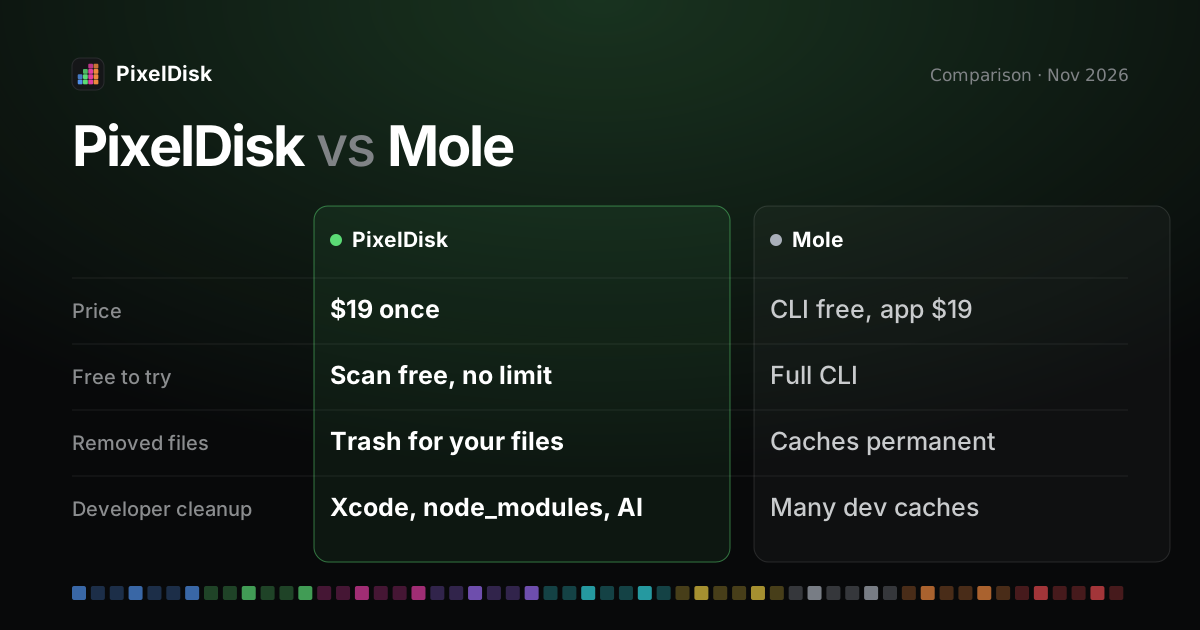
Quick answer Checked November 2026
Mole is a free open-source command-line cleaner with a separate Mac app ($19 for two Macs). PixelDisk is a native app for $19 once that shows the whole disk and labels what each item costs before you remove it.
- PixelDisk$19
- Mole · CLI$0
- Mole · Mac app$19
Pick PixelDisk if
- You want a visual app, not a terminal
- You want each item’s cost explained
- You want alerts and Autopilot
Pick Mole if
- You live in the terminal
- You want a free, open-source tool
- You need many package-manager caches
PixelDisk has two modes. Safe (the default) moves your files to the Trash, where you can put them back, and deletes caches and build files because apps recreate them. Full deletes everything at once after one confirmation.
Mole is a free open-source cleaner CLI (mo) plus a paid Mac app; PixelDisk is a Mac app whose Safe mode sends your own files to the Trash and labels what each item costs. Both apps cost $19 once; Mole’s covers 2 Macs and its CLI is free (Mole for Mac, checked November 2026).
The short version
Mole started as a terminal tool by tw93 and is one of the most popular open-source Mac cleaners. The CLI cleans caches, uninstalls apps, analyzes the disk, runs maintenance and shows live system stats. Mole for Mac wraps similar jobs in a native app, and adds fan controls on supported Macs.
PixelDisk is a narrower tool. It maps the startup disk, suggests the single biggest safe thing to clear, and says what removing each item costs. In Safe mode, your own files go to the Trash, and caches and build files are deleted at once. It has no CLI and no system tuning tools.
Comparison
| PixelDisk | Mole | |
|---|---|---|
| Price model | One-time | Free CLI; Mac app one-time |
| Price | $19 | CLI $0; app $19 for 2 Macs |
| Free tier | Scan and explore, no time limit | Full CLI; in the app, free scans and 2 uses of each paid tool |
| Disk map / view | Pixel bar of 9 categories, folder treemap | Treemap in the app; terminal list in mo analyze |
| Says what’s safe and what it costs | Yes, per item | Lists known-safe items; no per-item cost labels found |
| Developer cleanup | Xcode DerivedData and DeviceSupport, node_modules/target/build, git worktrees, AI models; simulators, Docker by kind and VM disks (direct edition) |
CLI: Xcode caches, Docker build cache, many package managers, mo purge for build folders; app: developer tools and AI tool cleanup |
| Where removed files go | Safe mode: your files go to the Trash; caches and build files are deleted (they rebuild) | Mixed: caches deleted permanently by default; uninstall and Analyze use the Trash |
| Undo / history | History log; put back while in the Trash | mo history log; undo only while items are in the Trash |
| Dry run | No dry run; Safe mode sends your files to the Trash | --dry-run on every CLI command that deletes |
| Open source | No | CLI yes (GPL-3.0); app source not stated |
| Platforms | macOS 14 or later | App: macOS 14+; CLI: macOS 12+, plus Windows and Linux versions |
Mole details from mole.fit and the GitHub README, checked November 2026. Not confirmed: the exact list of developer items in the Mole Mac app, and whether its source is open.
Where PixelDisk is different
What is deleted and what is trashed
Mole’s site says “Cache cleanup is permanent by default,” with a Trash option in Settings (Mole for Mac). In the CLI, mo clean, mo purge and mo installer delete permanently (README). PixelDisk’s Safe mode does the same for caches and build files: it deletes them at once because they rebuild. The difference is that large files, installers, downloads and models go to the Trash, and History logs every removal. Full mode deletes everything and asks first.
It labels what each removal costs
Mole sorts items into safe groups and lets you review them. PixelDisk adds a plain cost to each item, such as “Next build is slower”, “Downloads again” or “Apps rebuild them”. You can decide in one glance whether 20 GB of DerivedData is worth a slower build.
Developer items as one list in an app
The Mole CLI covers more package managers than PixelDisk. In PixelDisk, DerivedData, DeviceSupport, build folders, git worktrees and local models from Ollama, LM Studio and Hugging Face sit in one Developer category with sizes. The direct edition adds simulators, Docker by kind, and VM disks from Docker Desktop, OrbStack, Colima and Lima. See the guides on Xcode, Docker and AI models.
One pixel bar for the whole disk
PixelDisk shows the startup disk as one bar of nine categories, from Apps to Trash. It then points at the biggest safe win. Mole’s app uses a treemap, and the CLI uses a ranked terminal list.
Autopilot when space runs low
PixelDisk can clean safe items on its own when space runs low, and it warns about low space and fast fill rates from the menu bar. Autopilot always runs in Safe mode and only touches caches, logs and build files, which are deleted at once and logged in History.
What PixelDisk doesn’t do
- No command line, no
--dry-run, no JSON output. Mole’s CLI is scriptable and works with AI agents. - It is not open source. Mole’s CLI is GPL-3.0, so you can read every rule it applies.
- No free full version. Mole’s CLI costs nothing, and its app licence covers 2 Macs.
- No system maintenance, live CPU or memory stats, fan control or Touch ID for
sudo. Mole has all of these. - Startup disk only.
mo analyze /Volumescan look at external drives. - No Windows or Linux version. It needs macOS 14 or later.
- The App Store edition is sandboxed and sees only your Home folder. The Uninstaller, System Data breakdown, simulators, backups, Time Machine snapshots, VM disks and Docker cleanup need the direct download edition.
Who should stay with Mole
Stay with Mole if you live in the terminal, want cleanup in scripts or agent workflows, or care about open source. The CLI is free, well maintained, and its --dry-run previews are thorough. Stay with the Mole app if you want maintenance, status and fan tools in one place, and you are fine turning on the Trash option for caches. If you want a Mac app whose Safe mode sends your own files to the Trash and each item says what it costs, try PixelDisk for free and see pricing. Also compare the DevCleaner for Xcode alternative page.
Sources
Prices and features checked November 2026.
- Mole for Mac: https://mole.fit/
- Mole CLI on GitHub (GPL-3.0, about 75,000 stars): https://github.com/tw93/Mole
- Mole CLI safety notes: https://github.com/tw93/Mole#safety